 comparison
What Procedure Takes 10 Years Off Your Face?
Table of Contents
- Surgical Facelifts: The Gold Standard for Dramatic Results
- Nonsurgical Facial Rejuvenation Treatments That Deliver Impact
- Facelift Results Before and After: What's Realistic?
- Facelift Recovery Time and What to Expect
- How Long Does a Facelift Last?
- Laser Resurfacing and Skin Tightening for Gradual Rejuvenation
- Choosing Your Path: Surgical vs. Nonsurgical
- Frequently Asked Questions
Last Updated: October 19, 2026
Surgical Facelifts: The Gold Standard for Dramatic Results
A procedure takes 10 years off your face, and for most people seeking the most dramatic transformation, that procedure is a surgical facelift. We work with patients exploring every option for facial rejuvenation, and when someone wants to reverse significant signs of aging in a single treatment, a facelift delivers results nonsurgical alternatives cannot match. (Source: American Society of Plastic Surgeons' 2023 statistics)
A facelift, also called a rhytidectomy, lifts and tightens the face and neck by removing excess skin and repositioning underlying tissues. It addresses sagging skin, deep creases, and loss of facial definition that accumulate over decades.
Incisions are made around the hairline and ear, the skin is gently lifted, and the underlying musculature is tightened. Excess skin is trimmed away and incisions closed with precision sutures, yielding a more defined jawline, smoother cheeks, and a lifted appearance throughout the face and neck.
Recovery takes time: most patients have swelling and bruising for 2-3 weeks, with final results visible after 3-6 months as swelling resolves. That's the trade-off, dramatic results require downtime. For retirees or anyone who can manage a few weeks away from the office, it's a manageable investment.
Nonsurgical Facial Rejuvenation Treatments That Deliver Impact
Not everyone wants surgery. Many patients ask: can I take 10 years off my face without going under the knife?
The honest answer: no nonsurgical treatment reliably produces a decade of age reduction on its own. What they can do is improve the specific features that make a face read as older, volume loss, wrinkles, texture, and pigment, so the cumulative effect is a visibly fresher face.
Here is how the main categories compare on the dimensions that matter for a real decision:
Dermal fillers (hyaluronic acid and biostimulators). Best for volume loss, hollow cheeks, sunken temples, under-eye hollows, and thinning lips. Hyaluronic acid fillers last roughly 6-18 months; biostimulators such as poly-L-lactic acid and calcium hydroxylapatite last 1-2 years and trigger collagen. Downtime is minimal (possible bruising and swelling for a few days). Risks include bruising, lumps, vascular occlusion (rare but serious), and migration. Cost is per syringe and varies widely.
Neuromodulators (botulinum toxin). Best for dynamic expression lines, forehead, glabella (frown lines), and crow's feet. Results appear in 3-7 days, peak at about 2 weeks, and last roughly 3-4 months. No downtime. Risks are generally mild (bruising, temporary asymmetry, rare eyelid droop).
Laser resurfacing (fractional CO2 and erbium). Best for sun damage, age spots, uneven tone, fine lines, and texture.
Radiofrequency and microneedling (including RF microneedling). Best for mild to moderate skin laxity and early jowling. These stimulate collagen gradually over 3-6 sessions spaced weeks apart. Downtime is minimal to a few days of redness. Results are subtle, build over months, and typically need maintenance.
Chemical peels and skincare (retinoids, vitamin C, sunscreen). Best for tone, texture, and prevention. Superficial peels have little downtime; medium and deep peels can involve a week or more of peeling and carry pigment risks.
The strength of nonsurgical approaches is flexibility and staging: combine fillers for volume, neuromodulators for expression lines, and laser or RF for texture and laxity, adjusting over time. The weakness: none lifts sagging tissue the way a facelift does.
Facelift Results Before and After: What's Realistic?
The question everyone asks: how much younger will I actually look?
Realistic facelift results show a more defined jawline, lifted cheeks, smoother neck, and an overall refreshed appearance. The result depends on your starting point, skin quality, and surgical technique.
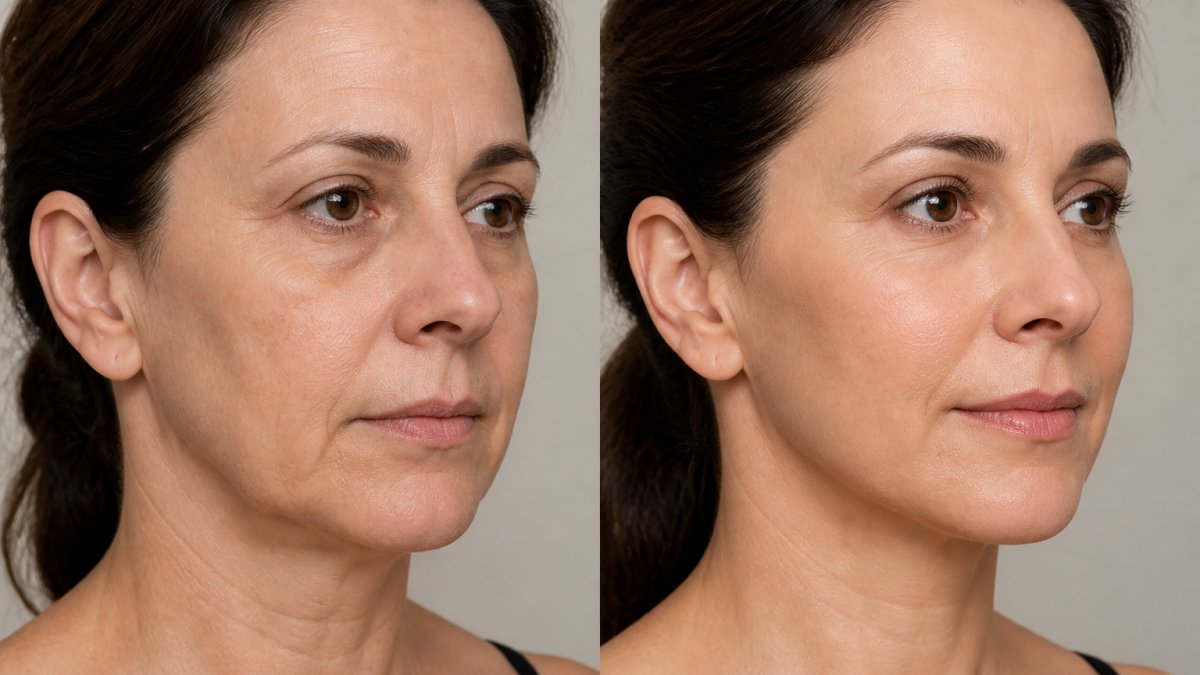
Here's what changes and what doesn't:
What improves dramatically: Jowls disappear or significantly reduce. The jawline becomes more defined. Cheeks lift and appear fuller. The neck tightens. Deep nasolabial folds (lines from nose to mouth) improve, though they rarely disappear completely. Skin texture improves if you combine the facelift with laser resurfacing.
What doesn't change: A facelift cannot eliminate fine lines completely, that requires laser resurfacing or injectables. It cannot change bone structure or the shape of your nose. It cannot remove age spots or sun damage (laser does that). It cannot prevent future aging.
The most important distinction: a facelift makes you look like a younger version of yourself, not a different person. If you're hoping for a transformation that defies your genetics or age, you'll be disappointed. If you want to reverse years of aging and restore facial definition, a facelift delivers. Maintaining these surgical improvements requires a commitment to consistent natural anti-aging steps that preserve your skin health and structural integrity over the long term.
Results are most dramatic in the first 3 months as swelling resolves, with subtle improvements continuing for up to a year as tissues settle and collagen remodels.
Facelift Recovery Time and What to Expect
Recovery is where surgical facelifts diverge most sharply from nonsurgical options. You cannot hide a facelift for a week or two. Your face will be visibly swollen and bruised.
Week 1: Significant swelling and bruising. Most patients wear a compression garment to minimize swelling. Pain is usually mild to moderate and controlled with prescribed medication. Avoid bending over, lifting heavy objects, or strenuous exercise, anything that raises blood pressure can worsen swelling and bruising.
Week 2-3: Swelling and bruising begin to fade but remain visible. Many patients return to light office work by week 2, often wearing hair down or using makeup to conceal residual bruising. Strenuous exercise remains off-limits.
Week 4-6: Most swelling has resolved. You can resume normal exercise and most activities. Some residual bruising may linger, but it's manageable with makeup.
3-6 months: Final results emerge as all swelling resolves and tissues settle. You'll notice continued improvements as collagen remodels.
The recovery timeline is one reason many patients choose nonsurgical options: Fraxel laser means 5-7 days of visible redness, fillers and Botox have no downtime, while a facelift requires 2-4 weeks before you feel comfortable in public.
How Long Does a Facelift Last?
This is the question that determines whether a facelift is worth the investment: how long do results actually last?
A facelift lasts 10-15 years for most patients, sometimes longer, though your face continues to age naturally. At year 10-15, you may look like you did at 50 rather than 35, still significantly younger than if you'd never had the procedure.
The longevity of a facelift depends on several factors:
Your genetics: If your parents aged quickly, you likely will too, even after a facelift.
Sun exposure: Cumulative sun damage accelerates aging. Patients who protect their skin with sunscreen and avoid excessive sun exposure maintain results longer.
Smoking: Smoking damages collagen and accelerates skin aging. Smokers see results fade faster than nonsmokers.
Lifestyle: Stress, poor sleep, and poor nutrition accelerate aging; healthy habits extend results.
Skin care: A good skincare routine, including retinoids, vitamin C, and sunscreen, helps maintain results.
After 10-15 years, you have options: a mini-facelift, injectables and laser treatments to maintain results without another full surgery, or simply letting your face age naturally again.
The key insight: a facelift is not permanent, but it is long-lasting. You're not committing to repeated surgeries every few years. You're investing in a decade-plus of looking significantly younger, then reassessing.
Laser Resurfacing and Skin Tightening for Gradual Rejuvenation
Laser resurfacing and radiofrequency skin tightening offer a different path: instead of one dramatic procedure, multiple sessions gradually improve skin quality and tighten lax skin.
Fractional CO2 and erbium lasers remove the outer damaged layers of skin while stimulating collagen production deep in the dermis. This treats age spots, sun damage, fine lines, and uneven skin texture. Results improve over 3-6 months as collagen remodels.
Recovery is more involved than injectables but less intense than surgery: expect 5-7 days of visible redness and peeling, then gradual improvement over weeks. Avoid sun exposure and follow strict skincare protocols.
Radiofrequency treatments like ThermiSmooth use heat energy to tighten skin without removing the outer layer. Recovery is minimal, just mild redness that fades within hours. Results build gradually over several sessions (typically 4-6 treatments spaced 2-4 weeks apart).
Laser and radiofrequency treatments shine when combined with injectables and fillers. The laser improves skin texture and tone. The fillers restore volume. Together, they create a refreshed appearance that approaches, though doesn't match, surgical facelift results.
The advantage: minimal downtime and no surgery. The disadvantage: results are more subtle and require ongoing maintenance. After 12-18 months, you'll likely need touch-up treatments to maintain results.
Choosing Your Path: Surgical vs. Nonsurgical
A direct comparison on the dimensions that actually drive the decision, candidacy, realistic results, downtime, risks, longevity, and cost over time, is more useful than a pros-and-cons list.
Candidacy. A facelift is generally best suited to patients with moderate to significant skin laxity, visible jowling, neck banding, and loss of jawline definition, who are in good general health and do not smoke.
Realistic results. A facelift produces the most dramatic and longest-lasting improvement in sagging and jawline/neck definition. It does not eliminate fine lines, remove pigment, or change bone structure, those require laser, injectables, or both.
Downtime. This is the sharpest divide. A facelift typically involves 2-4 weeks before patients feel comfortable in public, with swelling and bruising fading over several weeks and final results emerging at 3-6 months.
Risks. Surgery carries the risks of any operation, anesthesia, bleeding, infection, poor wound healing, scarring, nerve injury (usually temporary, rarely permanent), and asymmetry, plus the need for revision in some cases.
Longevity and maintenance. A facelift typically lasts 10-15 years, though the face continues to age naturally.
Cost over time. Surgical fees vary widely by market, surgeon, and whether anesthesia and facility fees are included, and are typically the largest single outlay. Nonsurgical costs are lower per session but recur.
A concern-based shortcut. If sagging and jowling dominate, surgery is usually the most efficient path. If volume loss dominates, fillers. If expression lines dominate, neuromodulators. If pigment and texture dominate, lasers or peels. If mild laxity dominates, RF or microneedling.
Frequently Asked Questions
Can a facelift really make you look 10 years younger?
A surgical facelift can significantly reduce visible signs of aging by lifting sagging skin, tightening facial tissues, and restoring facial contours. Results depend on your starting point, skin quality, surgeon skill, and realistic expectations. A consultation with a qualified surgeon can help you understand what's achievable for your specific concerns.
What nonsurgical procedures can make your face look younger without surgery?
Nonsurgical facial rejuvenation treatments include dermal fillers to restore volume, laser resurfacing to improve skin texture and reduce wrinkles, microneedling for collagen stimulation, and injectables like Botox for fine lines. Fraxel laser and fractional CO2 laser treatments address sun damage and skin tone irregularities. These options require less downtime than surgery but typically deliver more gradual results and may need maintenance treatments.
How long do facelift results last compared to nonsurgical treatments?
Facelift results typically last 7 to 10 years or longer, depending on skin quality and aging progression. Nonsurgical treatments like injectables usually last 3 to 6 months and require ongoing maintenance. Laser resurfacing results can last several years but may need periodic touch-ups. The longevity difference makes facelifts more cost-effective over time, though they carry higher upfront costs and recovery requirements.
What's the recovery time for a facelift versus nonsurgical options?
Facelift recovery typically takes 2 to 3 weeks for initial healing, with full results visible after 3 to 6 months. You may experience swelling, bruising, and numbness during this period. Nonsurgical treatments like injectables have minimal downtime, while laser resurfacing may cause redness and peeling for 3 to 7 days depending on intensity. Your provider can discuss which recovery timeline fits your schedule.