 how-to
Sculptra for Acne Scars: How It Works, Results & Cost
Last Updated: October 23, 2026
Quick Summary
Sculptra acne scars treatment works by rebuilding collagen under the skin rather than filling scars directly. The poly-L-lactic acid injectable triggers gradual collagen production that adds dermal support, lifting indented areas and smoothing texture over months. It works best for rolling and shallow boxcar scars, not deep ice-pick scars.
- Most visible improvement from collagen remodeling appears between months three and six.
- For tethered rolling scars, providers often combine subcision first with Sculptra to rebuild support.
- Ice-pick scars usually need punch excision, TCA CROSS, or fractional laser instead of Sculptra alone.
- Massage treated areas five minutes, five times a day, for five days to reduce nodule risk.
- Most patients see Sculptra benefits for up to two years, sometimes longer.
Table of Contents
- How Sculptra Works to Improve Acne Scars
- The Treatment Process: Assessment, Injection Technique, and Sessions
- Sculptra vs. Subcision for Acne Scars
- Sculptra for Acne Scars Before and After: Setting Realistic Expectations
- How Long Sculptra Results Last
- Sculptra Acne Scar Treatment Cost and Planning
- Risks, Side Effects, and Aftercare
- Frequently Asked Questions
How Sculptra Works to Improve Acne Scars
Sculptra acne scars treatment works by rebuilding collagen under the skin, not by filling the scar directly. The injectable is made of poly-L-lactic acid (PLLA), a synthetic material that the body gradually breaks down while triggering new collagen production.
That distinction matters. Most acne scar treatments either resurface the top layer or add temporary volume. Sculptra does neither. It works below the surface, in the dermis, where depressed scars form.
From PLLA to Collagen: The Remodeling Process
The process unfolds in stages. PLLA particles are injected into the deeper skin layers. Your body responds to them as a foreign material and starts building collagen around each particle. Over weeks and months, that collagen becomes a support structure.
The American Society of Plastic Surgeons' overview of injectable treatments notes that collagen stimulators work gradually rather than immediately. That slow ramp-up is the point. New collagen adds dermal support, which lifts indented areas and smooths skin texture over time.
- Weeks 1-4: PLLA begins breaking down; little visible change
- Months 1-3: collagen production ramps up; early softening of texture
- Months 3-6: collagen remodeling continues; most visible improvement
Which Scar Types May Respond: A Practical Decision Guide
Not every acne scar responds equally. Sculptra tends to help scars caused by volume loss and shallow depression. The scar assessment is where this gets decided. Below is a scar-type-specific guide to help you and your provider plan treatment.
Atrophic acne scars are the broad category, and they include several subtypes:
- Rolling scars: wide, shallow depressions with sloped edges. These often respond well because they involve volume loss and tethering. Sculptra can be used alone for mild rolling scars, but for tethered rolling scars, combining subcision (to release the fibrous bands) with Sculptra (to rebuild support) is often more effective. A common pattern is to perform subcision first, then inject Sculptra in the same session or a few weeks later.
- Boxcar scars: round or oval depressions with sharper edges. Response varies; shallower boxcars tend to do better. For deeper boxcar scars, Sculptra may be combined with fractional laser or microneedling to address both depth and surface texture. Your provider may also consider punch excision for isolated deep boxcars.
- Ice-pick scars: narrow, deep pockmarks. These are the hardest to treat and usually need a different approach. Sculptra alone is unlikely to produce satisfactory results. Instead, treatments such as punch excision, TCA CROSS (trichloroacetic acid chemical reconstruction of skin scars), or fractional laser may be more appropriate. Sculptra might still be used as an adjunct to improve overall skin texture, but it should not be the primary treatment for ice-pick scars.
A common mistake is expecting one treatment to fix every scar type. It won't. Deep ice-pick scars often need combination treatment.
What the Evidence Says (and Doesn't Say)
It's important to separate what is well-established from what is still uncertain. Strong comparative evidence for Sculptra acne scars treatment specifically is limited. Most published information comes from small case reports, clinical experience, and studies on Sculptra for facial volume loss (such as HIV-associated lipoatrophy). These sources suggest benefit for depressed scars, but large, randomized controlled trials focused on acne scars are lacking. This means that while many practitioners report good outcomes, the degree of improvement and the ideal treatment protocol are not yet firmly established.
The Treatment Process: Assessment, Injection Technique, and Sessions
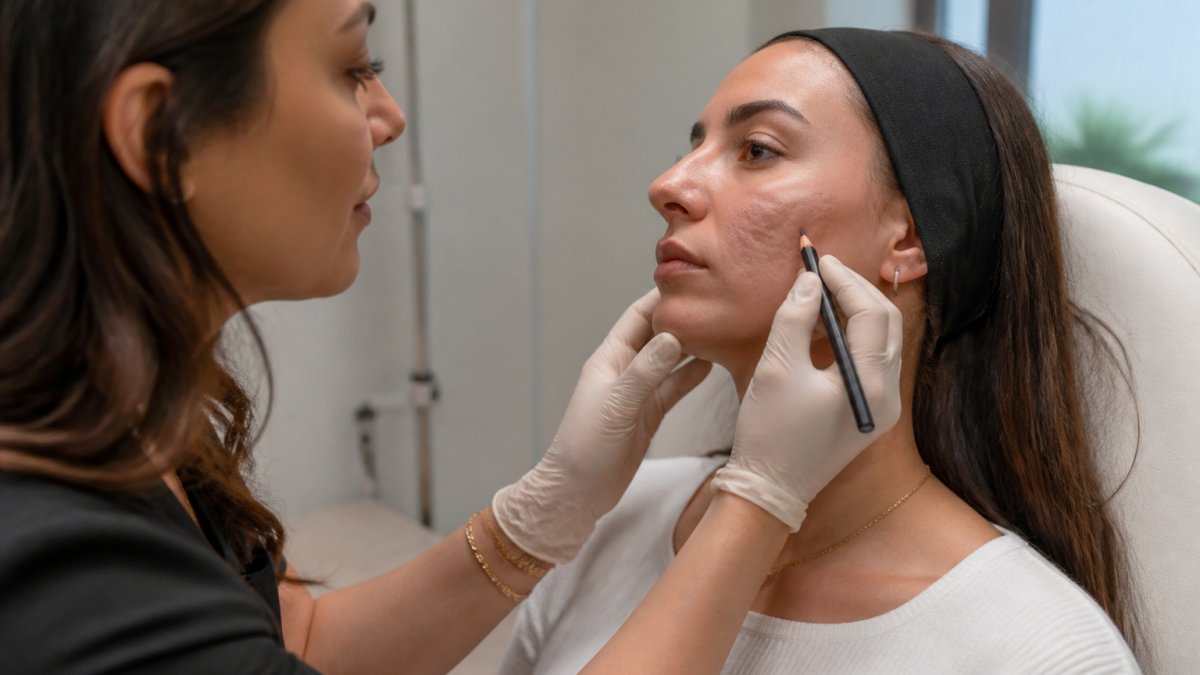
The treatment process starts with a scar assessment, not a syringe. A qualified provider examines scar depth, skin thickness, and facial contours to decide whether Sculptra is the right tool.
Scar Assessment and Candidacy
A good candidate has depressed scars, reasonable skin health, and realistic expectations. Providers check for active acne, which should be controlled first. They also review your history for conditions that affect healing.
The U.S. Food and Drug Administration's guidance on dermal fillers is clear that injectable treatments carry risks and belong in the hands of trained professionals. That is the standard we hold ourselves to at Lumyn Medspa: licensed providers and genuine products.
Fanning Technique and Injection Depth
Injection technique separates a good result from a mediocre one. PLLA is placed deep, in the dermis or the layer just below it, using a fanning technique.
Depth control matters because product placed too shallow can cause lumps. Micro-injections, delivered in small amounts across many passes, reduce that risk and give smoother collagen remodeling.
Sessions are typically spaced several weeks apart, and most treatment plans involve multiple visits.
For a closer look at how sessions, results, and aftercare fit together, and you can review the Sculptra service page to see whether this treatment fits your goals.
Sculptra vs. Subcision for Acne Scars
Sculptra and subcision solve different problems, which is why the comparison is not really either-or. Subcision is a minor procedure that uses a needle or small blade to cut the fibrous bands tethering a scar down. It releases the depression physically. Sculptra then rebuilds collagen and adds dermal support.
Here is how they differ:
| Factor | Sculptra | Subcision |
|---|---|---|
| Mechanism | Collagen stimulation | Physical release of tethers |
| Best for | Rolling and shallow boxcar scars | Tethered, bound-down scars |
| Onset | Gradual, over months | Often sooner after healing |
| Downtime | Minimal to moderate swelling | Bruising common |
| Combination use | Frequently paired with subcision | Often followed by a filler or stimulator |
For tethered rolling scars, many providers combine the two: subcision first to release the band, then Sculptra to rebuild support.
Sculptra for Acne Scars Before and After: Setting Realistic Expectations
Sculptra for acne scars before and after photos show improvement, not erasure. Patients who get the best outcomes understand that this is a gradual treatment with a ceiling.
What you can reasonably expect:
- Softer scar edges and improved skin texture
- Less shadowing from shallow depressions
- Better overall skin smoothing and facial contours
- Visible improvement that builds over months, not days
What you should not expect is flawless skin or complete removal of deep scars. Results vary by scar type, skin quality, and how many sessions you complete.
Real patient photos help set honest expectations. You can browse our before-and-after gallery to see real outcomes.
How Long Sculptra Results Last
How long Sculptra results last depends on your collagen response and lifestyle, but most patients see benefits for up to two years, sometimes longer. PLLA itself dissolves within months. The collagen your body builds in response is what lasts.
Results fade gradually as natural collagen turnover continues. Maintenance sessions can extend the effect. Smoking, sun exposure, and general skin health all influence how long results hold.
Sculptra Acne Scar Treatment Cost and Planning
Sculptra acne scar treatment cost varies by the number of vials, sessions, and the provider's treatment plan. There is no single price, because scar surface area and depth drive how much product you need.
Rather than quote a number that will not fit your case, we build a plan during consultation. To understand what drives pricing and how to budget, explore the cost of professional aesthetic treatment plans. That plan outlines sessions, vials per session, and spacing.
Risks, Side Effects, and Aftercare
Side effects are usually mild and temporary: redness, swelling, tenderness, and occasional bruising at injection sites. More serious risks include nodules or lumps under the skin, which proper injection depth and technique help prevent. Infection and allergic reaction are rare but possible.
The National Library of Medicine's research on poly-L-lactic acid describes these reactions as generally manageable when treatment is performed by trained providers.
Common Side Effects and What to Expect
Most patients experience some redness, swelling, and tenderness for a few days after treatment. Bruising is common and can last up to a week. These effects usually resolve on their own. Nodules (small lumps) can occur, especially if product is placed too superficially or if post-treatment massage is inadequate. Delayed nodules may appear weeks to months later and are often inflammatory. Proper technique and adherence to massage instructions significantly reduce this risk.
Contraindications: Who Should Not Have Sculptra
Sculptra is not appropriate for everyone. You should not receive Sculptra if you:
- Are pregnant or breastfeeding
- Have an active skin infection or inflammation in the treatment area
- Have a history of keloid formation or hypertrophic scarring
- Are allergic to any component of Sculptra (including lidocaine, if used)
- Have a compromised immune system or are on immunosuppressive therapy
- Have a bleeding disorder or are taking blood thinners (relative contraindication; discuss with your provider)
Your provider will review your medical history and may defer treatment until any active acne or infection is controlled.
Managing Complications: When to Call Your Provider
Most side effects resolve without intervention. However, contact your provider promptly if you experience:
- Persistent or worsening lumps that do not resolve after massage
- Signs of infection (increasing redness, warmth, pain, fever)
- Skin discoloration or blanching
- Any visual changes (rare, but possible if product is injected near the eye)
Early intervention can often resolve complications more easily. Your provider may recommend massage, warm compresses, or in some cases, medication.
Aftercare: Step-by-Step
Proper aftercare supports healing and results. Follow these steps:
- Massage the treated areas as instructed (typically five minutes, five times a day, for five days) to spread product evenly and reduce nodule risk.
- Avoid strenuous exercise and alcohol for the first 24 hours to minimize swelling and bruising.
- Skip harsh skincare (retinoids, exfoliants) and sun exposure while skin settles.
- Use a gentle cleanser and moisturizer, and apply sunscreen daily.
- Report any persistent lumps or unusual swelling promptly.
Good preparation improves healing. Learn how to prepare your skin for aesthetic procedures.
Frequently Asked Questions
Does Sculptra work on acne scars?
Sculptra can soften indented acne scars by stimulating collagen production over several months. It works best on rolling and boxcar scars where volume loss and shallow depression are present, and less predictably on deep ice-pick scars. Results build gradually rather than appearing immediately, and most people need a series of sessions. A consultation with a qualified provider is the only way to know whether your specific scar pattern is likely to respond.
Is Sculptra or subcision better for acne scars?
The two address scars differently. Subcision physically releases fibrous bands that tether a scar downward, which helps rolling scars. Sculptra builds collagen to add dermal support and smooth texture over time. Many treatment plans combine them: subcision releases the tether, then Sculptra supports the remodeled tissue. Which is better depends on scar type, depth, and how much volume loss is involved, so a scar assessment should guide the choice.
How many Sculptra treatments are needed for acne scars?
Most acne scar plans involve two to four sessions spaced about four to six weeks apart, though the number depends on scar severity, treatment area, and how much collagen response you show. Some providers use a staged approach with smaller volumes per visit. Your provider will reassess at each session and adjust the plan. Sculptra acne scars treatment is rarely a single-visit fix.
How much does Sculptra for acne scars cost?
Pricing varies by the number of vials used, the size of the treatment area, and the provider's location and credentials. Because a full plan often requires multiple sessions and several vials, total cost is best discussed as a treatment plan rather than a per-session figure. Ask for a written estimate covering the full course, including any follow-up visits, before committing. Lumyn Medspa can provide current pricing at consultation.