 ultimate-guide
Safe Laser Treatments for Dark Skin: 2026 Guide
Table of Contents
- Why Safe Laser Treatments for Dark Skin Require a Different Approach
- How Melanin and the Fitzpatrick Scale Shape Laser Safety
- Nd:YAG Laser for Dark Skin: Why It Is the Gold Standard
- Laser Hair Removal Side Effects Dark Skin Patients Should Know
- Laser Skin Rejuvenation Recovery Time: What to Expect Week by Week
- Pre-Treatment Preparation and Safety Protocols for Melanin-Rich Skin
- The Psychological Impact of Failed Laser Treatments
- Frequently Asked Questions
Last Updated: September 15, 2026
Why Safe Laser Treatments for Dark Skin Require a Different Approach
Safe laser treatments for dark skin require a different approach because melanin absorbs laser energy before it reaches the intended target. In lighter skin, that competition is minimal. In melanin-rich skin, it is the central variable that determines whether a treatment produces an even result or a burn.
This guide covers how wavelength, pulse duration, and skin phototype interact, which technologies are safest, and how to vet a provider.
The stakes are not cosmetic. Dark skin carries a documented risk of post-inflammatory hyperpigmentation and, less commonly, hypopigmentation after laser injury (pubmed.ncbi.nlm.nih.gov). A device that performs well on Fitzpatrick I or II skin can cause thermal injury on Fitzpatrick V or VI when settings ignore epidermal melanin.
Below: the technologies that work, the recovery timeline, and the red flags that should end a consultation early.
How Melanin and the Fitzpatrick Scale Shape Laser Safety
The Fitzpatrick skin phototype system classifies skin by melanin production and response to ultraviolet exposure. It remains the standard framework for selecting laser parameters, and a qualified provider should establish it before treatment.
The Six Fitzpatrick Skin Phototypes
- Type I: Pale skin, always burns, never tans
- Type II: Fair skin, usually burns, tans minimally
- Type III: Medium skin, sometimes burns, tans gradually
- Type IV: Olive or light brown skin, rarely burns, tans easily
- Type V: Brown skin, very rarely burns, tans deeply
- Type VI: Deeply pigmented brown or black skin, never burns
Higher phototypes carry more epidermal melanin, meaning more competition for laser energy at the skin's surface, the entire safety problem in one sentence.
How Epidermal Melanin Interacts With Laser Light
Laser energy is absorbed by chromophores, and melanin is one. When a device targets hair follicles or pigment deeper in the dermis, surface melanin absorbs part of that energy first and converts it to heat, causing unwanted thermal injury to the epidermis.
Selective photothermolysis, the principle behind most safe laser treatments for dark skin, matches wavelength and pulse duration so the target absorbs energy faster than surrounding tissue can dissipate it. Longer wavelengths bypass epidermal melanin more effectively; longer pulse durations give the surface time to cool (pubmed.ncbi.nlm.nih.gov). Get either wrong and the patient pays for it.
How Fitzpatrick Type IV-VI Translates Into Actual Laser Settings
Most guides stop at the phototype chart. What actually protects you is how a clinician converts your phototype into device settings. Four parameters do the work:
- Wavelength: Longer wavelengths (1064 nm Nd:YAG, and to a lesser degree 755 nm alexandrite with aggressive cooling) are absorbed less by epidermal melanin than 755 nm or 810 nm diode platforms. For Fitzpatrick V-VI, 1064 nm is the default starting point for hair reduction and vascular targets.
- Pulse duration: Longer pulses (typically in the millisecond range for hair removal) let the epidermis shed heat between pulses. Very short pulses concentrate heat in surface melanin and raise burn risk on darker phototypes.
- Fluence: This is where most injuries originate. A clinician treating Fitzpatrick V or VI should start at the low end of the device's effective range and titrate upward based on the patient's response, not apply the same fluence used on a Fitzpatrick II patient.
- Spot size and cooling: Larger spot sizes penetrate deeper but deposit more total energy. Integrated contact cooling or a chilled tip is not a luxury on darker skin; it is part of the safety margin.
A useful rule of thumb: as Fitzpatrick type increases, wavelength goes longer, pulse duration goes longer, and fluence starts lower. If a provider cannot explain how they adjust these four for your phototype, the consultation is not finished.
Why the Fitzpatrick Scale Alone Is Not Enough
The scale is a starting point, not a prescription. Two Type V patients can have very different melanin density, skin thickness, and PIH history. That is why a patch test and a conservative first session matter more than the number on the chart: the phototype says where to begin, your skin's response says where to stop.
Nd:YAG Laser for Dark Skin: Why It Is the Gold Standard
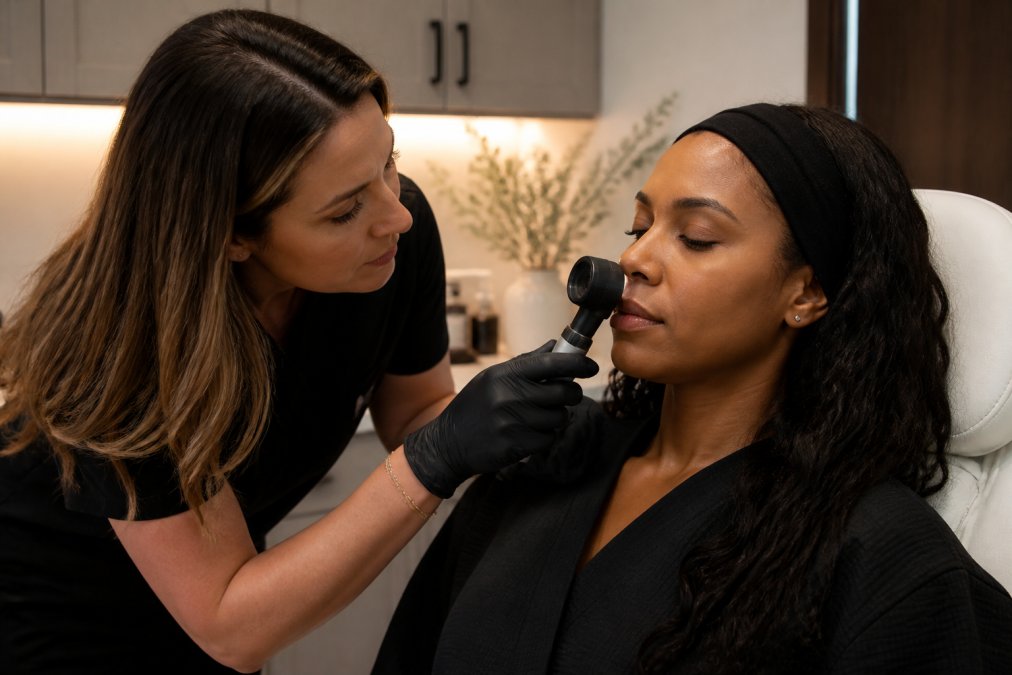
The Nd:YAG laser is the gold standard for dark skin because its 1064 nm wavelength penetrates deeper while being absorbed less by epidermal melanin than shorter-wavelength devices, making it the safest common platform for laser hair removal and vascular work on Fitzpatrick IV through VI.
What most guides miss: the Nd:YAG advantage disappears with aggressive fluence. The wavelength reduces risk, it does not eliminate it. Long-pulsed settings and conservative fluence are what actually protect the epidermis.
For skin rejuvenation and texture, non-ablative fractional lasers are often paired with Nd:YAG platforms. They create columns of controlled thermal injury while leaving surrounding tissue intact, shortening recovery and lowering hypopigmentation risk versus ablative resurfacing.
Laser Hair Removal Side Effects Dark Skin Patients Should Know
Laser hair removal side effects dark skin patients should know about fall into two categories: expected and warning.
| Reaction | Typical Timing | What It Means |
|---|---|---|
| Erythema | First few hours | Expected; usually settles quickly |
| Follicular swelling | 24-48 hours | Normal response to treatment |
| Post-inflammatory hyperpigmentation | Days to weeks | Usually settings were too aggressive |
| Hypopigmentation | Weeks | Less common; requires clinical review |
| Blistering or crusting | Within 48 hours | Stop treatment; contact the provider |
Laser Skin Rejuvenation Recovery Time: What to Expect Week by Week
A realistic non-ablative timeline looks like this:
Why At-Home Laser and IPL Devices Are a Different Risk Category
Recovery Red Flags That Mean Stop, Not Wait
What Actually Speeds Recovery on Darker Skin
Pre-Treatment Preparation and Safety Protocols for Melanin-Rich Skin
Patch Testing and Consultation Red Flags
Watch for these red flags during a consultation:
The Psychological Impact of Failed Laser Treatments
Frequently Asked Questions
What type of laser is safe for dark skin?
Long-pulsed Nd:YAG lasers with a 1064 nm wavelength are widely considered the safest choice for Fitzpatrick skin types IV through VI. This longer wavelength bypasses the epidermal melanin that gives darker skin its color and targets pigment or hair follicles deeper in the dermis. Diode and alexandrite lasers carry a higher risk of burns and post-inflammatory hyperpigmentation on melanin-rich skin, so a consultation with a qualified dermatologist or cosmetic surgeon is essential before any treatment.
Are there specific laser technologies designed for skin of color?
Yes. Nd:YAG platforms, non-ablative fractional lasers, and long-pulsed devices with adjustable pulse duration and fluence are engineered to work safely on melanin-rich skin. These systems let the provider cool the surface and deliver energy in controlled bursts, which limits thermal injury to the epidermis. Ask your provider which device they use and whether it has published clinical studies on Fitzpatrick type IV to VI patients.
What are the risks of laser hair removal on dark skin?
The main risks are post-inflammatory hyperpigmentation (PIH), hypopigmentation, burns, and blistering. These occur when the laser energy is absorbed by epidermal melanin instead of the hair follicle, causing thermal injury. Choosing an experienced provider who uses an Nd:YAG laser, performs a patch test, and adjusts fluence based on your Fitzpatrick skin phototype dramatically lowers these risks. Always disclose any recent sun exposure or tanning before your session.
How should I prepare my skin before a laser treatment?
Stop sun exposure and tanning beds at least two to four weeks before your appointment. Use broad-spectrum SPF 30 or higher daily, and avoid retinoids, glycolic acid, and other exfoliants for about a week unless your provider says otherwise. Arrive with clean skin, free of makeup or lotion. A patch test on a small area at least 24 to 48 hours before the full session is a standard safety-first approach for darker skin tones.
How long is the recovery time after laser skin rejuvenation?
Non-ablative fractional laser treatments typically involve 3 to 7 days of redness (erythema) and mild swelling, with most patients returning to normal activities within a week. Ablative resurfacing can require 7 to 14 days of visible healing. Darker skin tones may see temporary darkening at treated sites that fades over several weeks. Strict sun protection with SPF 30 or higher during recovery is critical to prevent PIH.
Does insurance cover laser treatments for dark skin?
Most cosmetic laser treatments are not covered by insurance because they are considered elective. However, if a laser is medically necessary, for example to treat severe acne scarring, certain pigmentation disorders, or a documented skin condition, some plans may cover part of the cost. Check with your insurer directly and ask your provider for a letter of medical necessity. Pricing for elective treatments varies by provider and treatment area, so request a quote during your consultation.
Choosing a provider for laser treatment on melanin-rich skin comes down to whether they treat your phototype as a variable or an afterthought. Lumyn Medspa approaches every plan with a skin assessment first, technology matched to your Fitzpatrick type, and a customized schedule that respects how your skin actually heals. Book a consultation to find out which options suit your skin and what a realistic timeline looks like for your goals.